
When you buy a Shared Hosting plan, your website usually shares the same server and IP address with many other websites. This is normal and works perfectly for most websites.
However, some hosting providers also offer a Dedicated IP with Shared Hosting.
So, what exactly is a Dedicated IP, and why might you need one?
What Is an IP Address?
An IP address is like the internet address of a server.
For example:
103.120.50.10
When someone visits your website, the domain name points to the server’s IP address so the browser can find your website.
In Shared Hosting, many websites can use the same IP address.
Example:
- website-one.com → 103.120.50.10
- website-two.com → 103.120.50.10
- website-three.com → 103.120.50.10
All three websites are hosted on the same Shared Hosting server and may use the same IP.
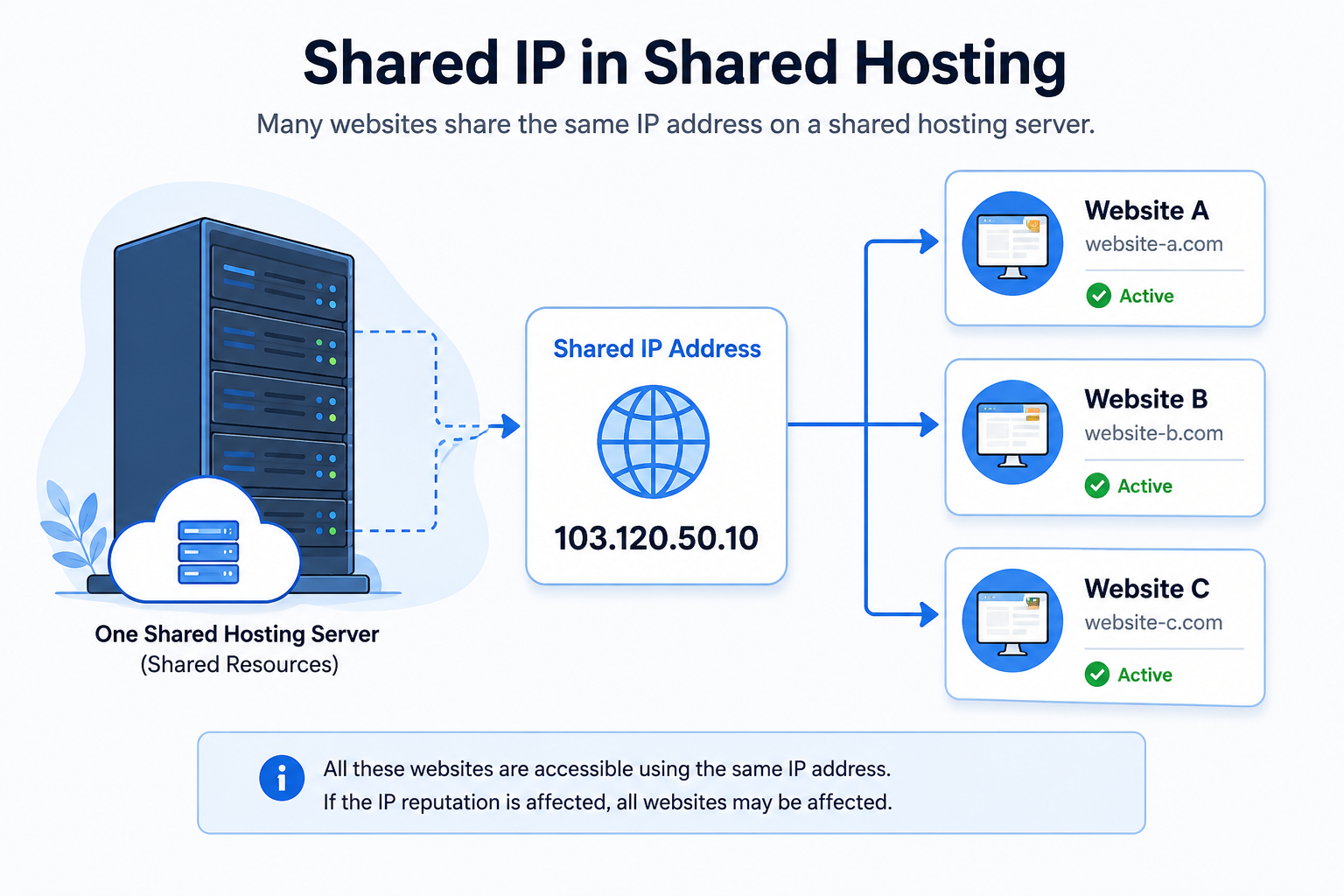
One Server → One Shared IP → Multiple Websites
This will help beginners understand Shared IP very quickly.
What Is a Dedicated IP?
A Dedicated IP is a unique IP address assigned specifically to your hosting account or website.
Instead of sharing one IP with many websites, your website gets its own IP.
Example:
Without Dedicated IP:
YourWebsite.com → 103.120.50.10
Other websites also use:
103.120.50.10
With Dedicated IP:
YourWebsite.com → 103.120.50.25
Your website now has a separate IP address.
Shared IP
- Website A
- Website B
- Website C
→ Same IP
Dedicated IP
- Your Website
→ Separate IP
This should be one of the main images of the blog.
Why Is a Dedicated IP Useful?
A Dedicated IP can provide several advantages depending on how your website or hosting account is being used.
1. Better Isolation from Other Users
This is one of the most important advantages.
In Shared Hosting, many websites may use the same IP address.
Suppose one website on the server gets hacked and starts sending spam emails.
For example:
Website D → Sends thousands of spam emails
Email providers or blacklist services may detect suspicious activity coming from the server IP.
If multiple websites are using that same IP, other websites may also be affected by the IP’s poor reputation.
With a Dedicated IP, your website has a separate IP address, which reduces the chance of another hosting user’s activity directly affecting your IP reputation.
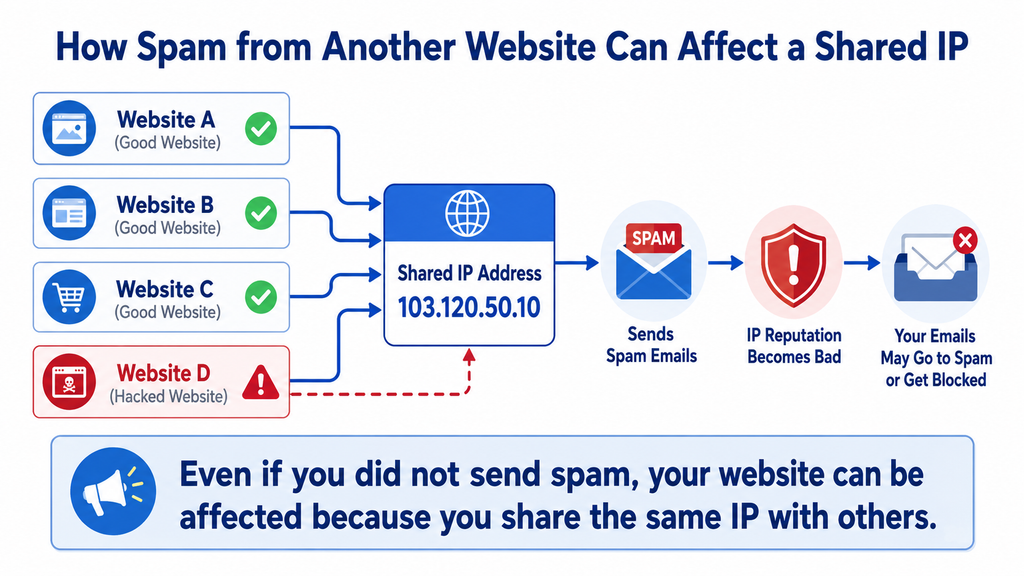
Shared IP: 103.120.50.10
Website A ✅
Website B ✅
Website C ✅
Website D → Spam ❌
Then:
Shared IP Reputation → Affected
Beside it show:
Your Dedicated IP: 103.120.50.25 → Separate ✅
2. Useful for IP Whitelisting
Some APIs, corporate systems, payment-related services, firewalls, or third-party platforms only allow connections from approved IP addresses.
This is called IP Whitelisting.
For example, a service may tell you:
Only requests coming from your approved server IP will be accepted.
If your hosting has a fixed Dedicated IP, you can provide that IP to the service provider.
Example:
Allowed IP: 103.120.50.25
The system can then allow requests only from that IP.
This can be especially useful for:
- API integrations
- Corporate systems
- Private applications
- Firewall rules
- Remote database access
- Certain payment or third-party integrations
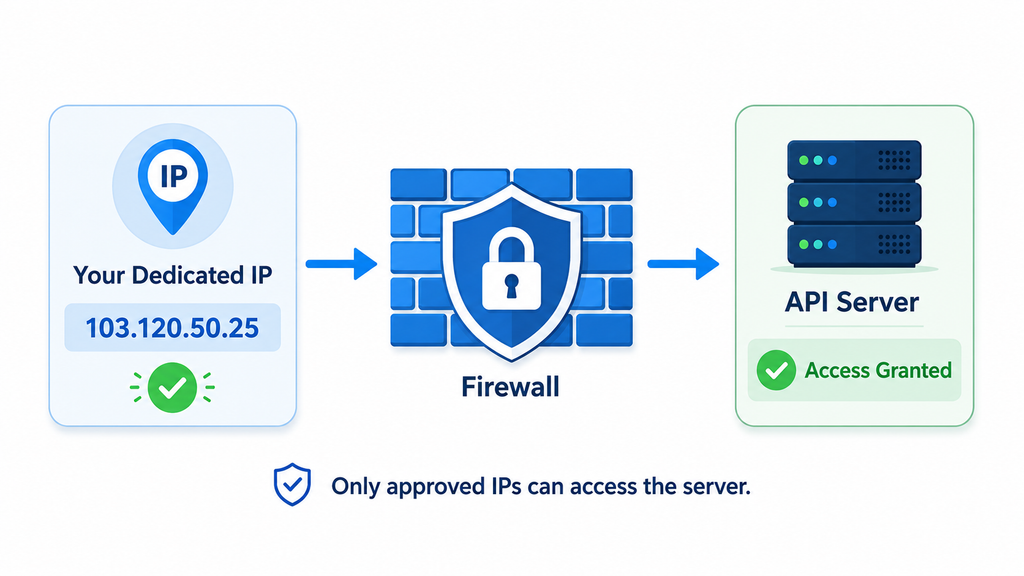
Your Dedicated IP → Firewall → API Server ✅
And another unknown IP:
Unknown IP → Firewall → Blocked ❌
3. A Unique IP for Your Website
With a Dedicated IP, your hosting account gets a unique IP instead of sharing the same IP with many other hosting accounts.
For example:
yourwebsite.com → 103.120.50.25
This can be useful when you need a fixed server identity for certain technical configurations or third-party services.
4. Helpful for Certain Email Configurations
Dedicated IPs can also be useful for email reputation, but there is an important point to understand.
Simply having a Dedicated IP for your website does not always mean your outgoing emails will use that IP.
Your hosting server must also be configured to send outgoing emails through the Dedicated IP.
If outgoing mail is correctly configured with a Dedicated IP, you have more control over your own sending reputation instead of sharing the same sending IP reputation with many users.
For example:
Shared Mail IP:
100 websites → Same Sending IP
If some accounts send spam, the reputation of that IP may be affected.
Dedicated Mail IP:
Your Account → Your Own Sending IP
However, email delivery still depends on many other factors, including:
- SPF
- DKIM
- DMARC
- Domain reputation
- Email content
- Sending behavior
- IP reputation
So, a Dedicated IP does not guarantee that every email will reach the inbox.
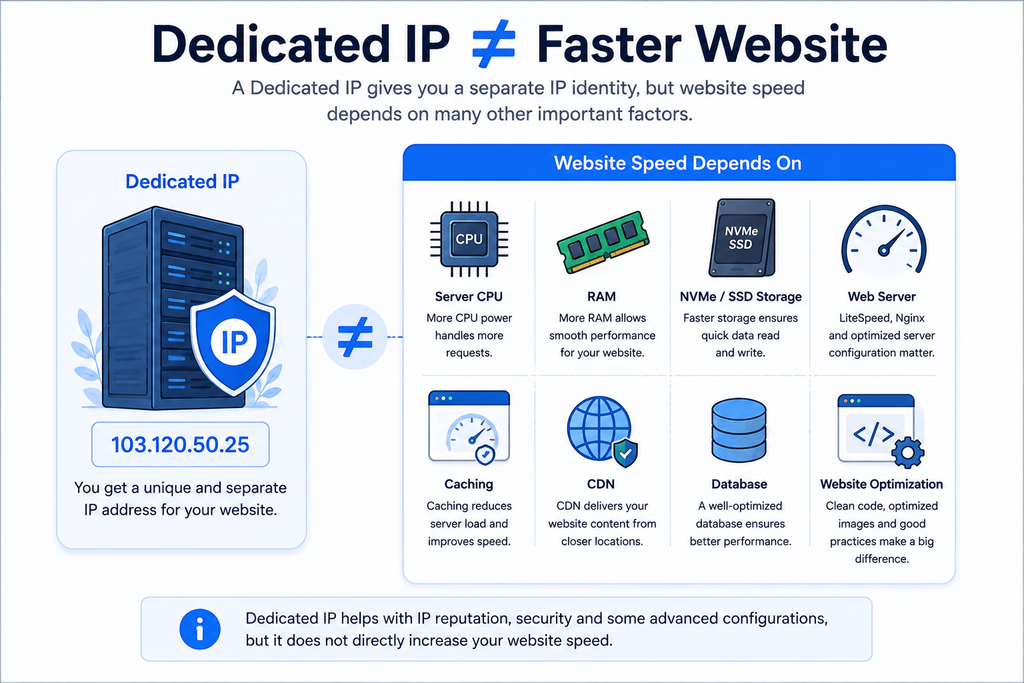
Does a Dedicated IP Make Your Website Faster?
No.
A common misunderstanding is that a Dedicated IP automatically makes a website faster.
Website speed mainly depends on things such as:
- Server CPU
- RAM
- NVMe or SSD storage
- LiteSpeed or other web servers
- Caching
- CDN
- Website optimization
- Database performance
A Dedicated IP mainly provides a separate IP identity. It does not provide additional CPU, RAM, or server resources.
Is a Dedicated IP Required for SSL?
In the past, Dedicated IPs were commonly required for SSL certificates.
Today, modern servers support technologies such as SNI (Server Name Indication).
Because of this, multiple websites can use SSL certificates while sharing the same IP address.
So, for most modern Shared Hosting users:
A Dedicated IP is not required just to use HTTPS or SSL.
Shared IP vs Dedicated IP
| Feature | Shared IP | Dedicated IP |
|---|---|---|
| IP Address | Shared with multiple websites | Separate IP for your account |
| Cost | Usually included | May cost extra |
| IP Reputation | Can be influenced by shared usage | More isolated |
| IP Whitelisting | Less suitable | Very useful |
| Website Speed | Normal | No automatic speed increase |
| SSL Support | Yes | Yes |
| Unique Server IP | No | Yes |
Who Should Consider a Dedicated IP?
You may consider getting a Dedicated IP if:
- You need a fixed IP for API whitelisting.
- A third-party service requires a unique server IP.
- You want better IP-level isolation from other Shared Hosting users.
- You have special server or security configurations.
- Your application requires a fixed outbound IP.
- Your hosting provider supports outgoing email through your Dedicated IP and you need more control over mail reputation.
For a basic blog, portfolio, or small business website, a Dedicated IP may not always be necessary.
Dedicated IP Does Not Mean Dedicated Server
This is another important point.
If you have:
Shared Hosting + Dedicated IP
you are still using Shared Hosting.
You are only getting a separate IP address.
You are not getting dedicated CPU, RAM, storage, or a complete server.
For example:
Shared Hosting + Dedicated IP
Still:
- CPU → Shared
- RAM → Shared
- Server → Shared
- Storage infrastructure → Shared
- IP → Dedicated
If you need dedicated or guaranteed server resources, you should consider a VPS or Dedicated Server instead.
Shared Hosting + Dedicated IP
Shared CPU ✅
Shared RAM ✅
Shared Server ✅
Dedicated IP ✅
This will prevent customer confusion.
Final Thoughts
A Dedicated IP in Shared Hosting means your hosting account or website gets a separate IP address instead of using the same IP as many other websites.
Its biggest practical advantages are better IP-level isolation and the ability to use a fixed IP for services such as API whitelisting, firewall rules, and certain advanced integrations.
However, a Dedicated IP does not automatically make your website faster, does not provide dedicated server resources, and is usually not required just for SSL.
For regular websites, a Shared IP is often enough. But if your website or application needs a fixed, unique IP address, a Dedicated IP can be a useful addition to your Shared Hosting plan.

